sat suite question viewer
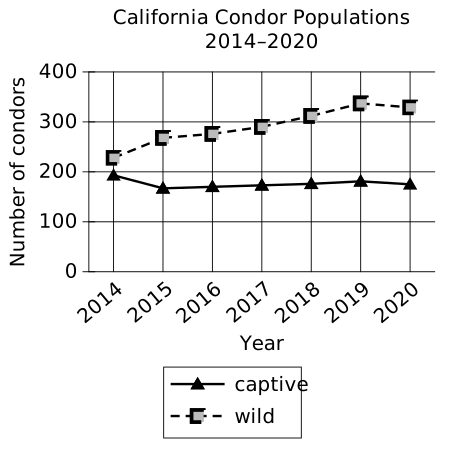
- The following 2 lines are shown:
- captive
- wild
- The captive line:
- Begins at 2014, 193 condors
- Falls gradually to 2015, 167 condors
- Rises gradually to 2016, 170 condors
- Rises gradually to 2017, 173 condors
- Rises gradually to 2018, 176 condors
- Rises gradually to 2019, 181 condors
- Falls gradually to 2020, 175 condors
- The wild line:
- Begins at 2014, 228 condors
- Rises gradually to 2015, 268 condors
- Rises gradually to 2016, 276 condors
- Rises gradually to 2017, 290 condors
- Rises gradually to 2018, 312 condors
- Rises gradually to 2019, 337 condors
- Falls gradually to 2020, 329 condors
The California Condor Recovery Program is working to protect this large, rare American vulture from extinction. The program captured 27 wild condors in 1987 in order to protect and breed them. Captive birds have been reintroduced into the wild since 1992. Although the California condor is still a rare species, many biologists claim that the program has been reasonably successful.
Which choice best describes data from the graph that support the biologists’ claim?
Explanation
Choice D is the best answer because it best describes data from the graph that support the biologists’ claim. The text accompanying the graph describes the efforts of the California Condor Recovery Program, which is working to protect the condor from extinction. The program captured some condors in 1987 in order to breed them and has been reintroducing captive birds into the wild since 1992. Many biologists claim the program has been a success, as the text explains, and it is reasonable to infer that an indication of the program’s success would be an increase in the wild condor population compared to the captive condor population. The graph shows the wild and captive condor populations in California between 2014 and 2020. In 2014 there were slightly more than 200 wild condors in California, but by 2020 there were more than 300. Meanwhile, over the same period the captive condor population remained under 200. Thus, the biologists’ claim about the program’s success is supported by data from the graph showing that the number of wild California condors increased overall from 2014 to 2020 and exceeded the number of those living in captivity.
Choice A is incorrect because it does not accurately describe data from the graph. The number of captive California condors did not steadily decrease between 2014 and 2020: rather, it increased slightly during some years and decreased slightly during others, generally remaining at slightly less than 200. Choice B is incorrect. Even though the graph does show a slight decrease in both the captive and wild condor populations from 2019 to 2020, such a decrease during a particular year would not demonstrate the program’s success. Choice C is incorrect because it does not accurately describe data from the graph. The difference between the number of captive and wild California condors did not remain relatively steady between 2014 and 2017. While the number of captive condors remained roughly the same during that period, the number of wild condors increased, so the difference between the number of captive and wild condors increased as well.